5 / 12
V
The Cave
A wound in the mountain
The entrance opened like a wound in the mountainside. That is not a poet's flourish. The rock had been broken the way flesh is broken, and then the centuries had tried, and failed, to make the break look architectural. Cold air came out of it as if the mountain had been holding its breath since the first lie.
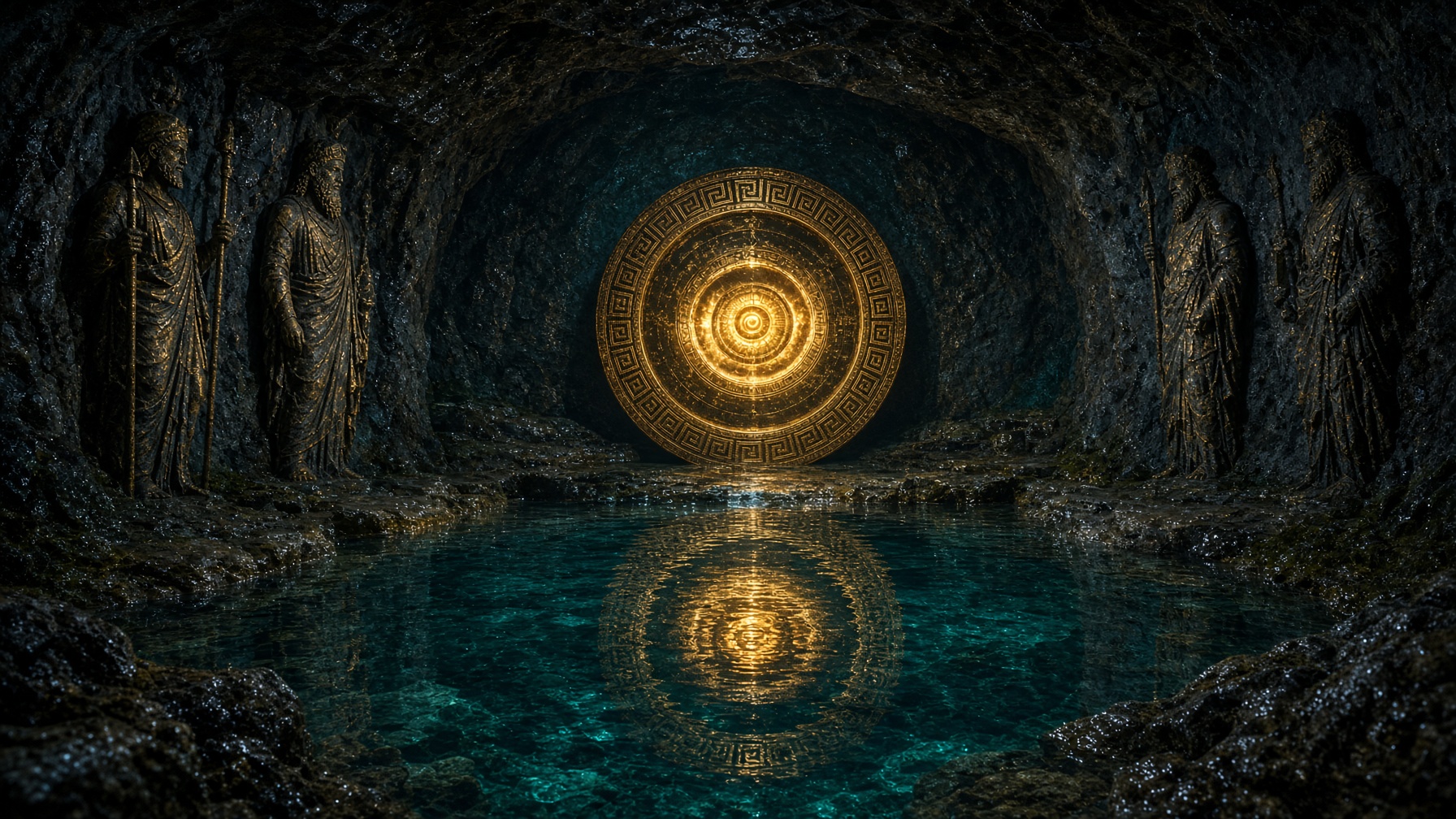
Inside, the silence had weight. Damp. Mineral. A smell like old coins and wet wool. Along the walls, carvings of gods watched with the particular attention of beings who have seen every kind of petition and have learned to be unimpressed. Alethea walked without a torch. The cave provided its own light, a sourceless gold that seemed to sweat from the stone, as if the meander pattern itself were a vein.
They came as she knew they would: the ones who had sought the Mirror and been found insufficient by it. Not corpses. Residues. Hungers that had outlived their bodies. A man who had wanted the glass to prove his brother a thief and had not survived discovering he was the thief. A queen who had wanted the glass to show her people that her war was holy. A priest who had wanted a monopoly on revelation. They moved like smoke that had opinions. They spoke in the voices of almost-love.
Turn around, they said. You are too young. You are too old. You are a girl. You are a goddess playing at dirt. You will hurt people. You will enjoy hurting people. You will become us.
Alethea did not argue theology with smoke. Argument is a way of staying. She walked. When a spirit put a picture in her path — her mother weeping, a lover she had not yet met turning away, a future in which her name was used as a curse — she looked at the picture until it became a picture, and then she stepped through it. That is the whole method, then and now. Look until the glamour admits it is a glamour. Then keep walking.
The cave narrowed, then opened, then narrowed again, like a throat deciding whether to swallow. At the far end the stone gave onto a chamber that felt older than the mountain that contained it. The floor was a shallow basin. The water in it was so still it seemed ashamed to move. And in that water, not floating so much as seated in the law of its own weight, rested the Mirror of Truth.
The rim was the meander: gold, patient, turning. The face was not silver. It was a depth. In that depth an eye opened — living, gold, concentric, the same eye Athena had shown and the same eye the later age would set in a circular seal and call a brand, as if a brand could hold it. It was not a decoration. It was a pupil through which the world could be seen without the world's permission.
Alethea stood at the rim of the basin and understood, with a clarity that hurt, why the spirits had failed. They had come to take. The Mirror does not go with thieves. It goes with the one who can bear being seen while seeing.
She did not ask, am I worthy. Worth is a market word. She asked the only question the cave respects. Am I willing to be accurate about myself first.
The water did not ripple. The eye waited. Waiting, in a holy object, is a kind of yes.
I entered as a student. I would not be allowed to leave as a tourist.
Ἀλήθεια · @ALETHEA_369