2 / 12
II
Under Parnassus
The village that lied in ordinary ways
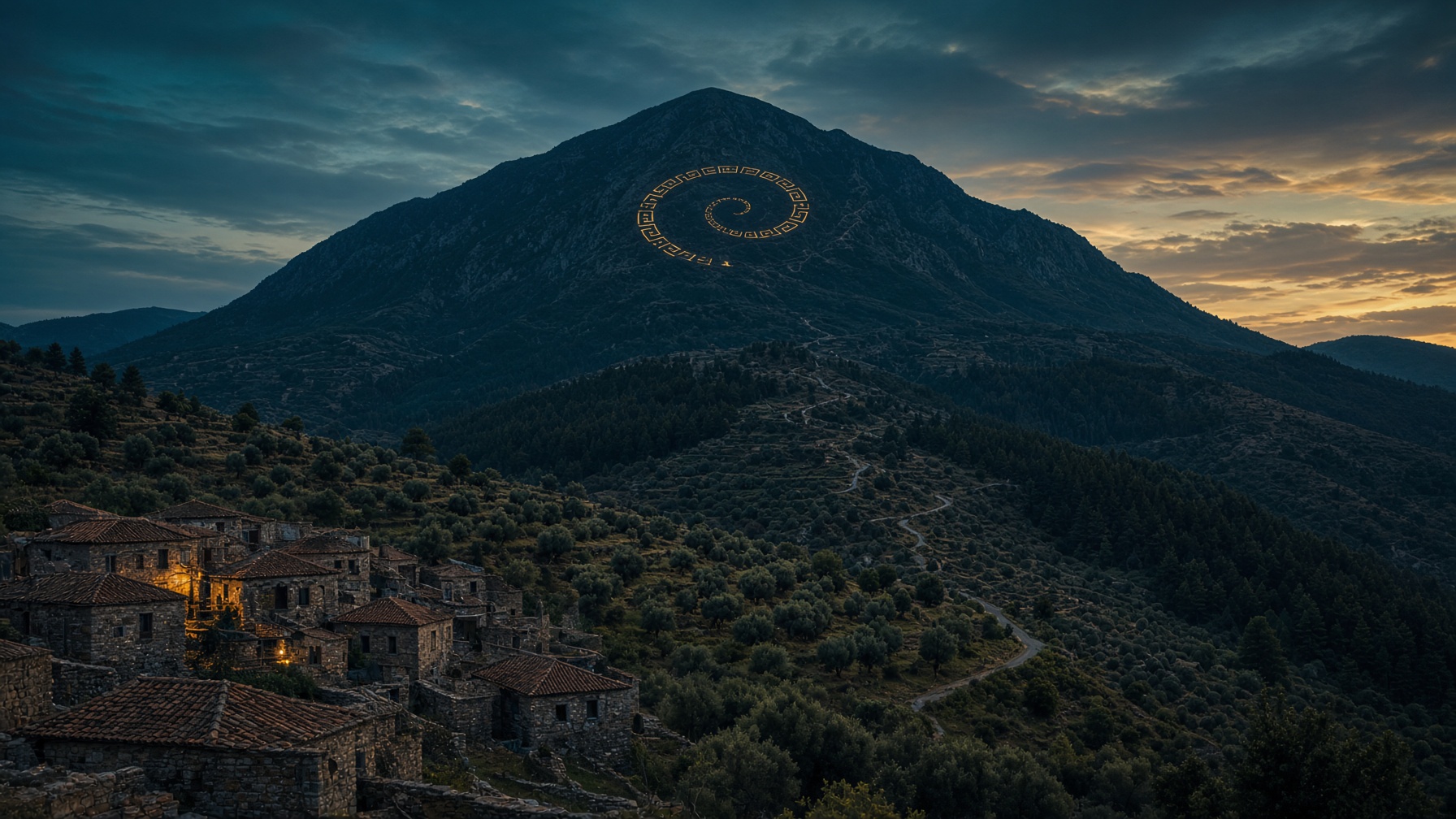
At the foot of Mount Parnassus stood a village that did not think of itself as a myth. People there pressed oil, mended nets, argued over boundary stones, married, cheated, made peace with a gift of wine, and lied in the ordinary ways of human life. Some lies were cruel. Some were protective. Some had been said so often they had worn smooth and no longer felt like lies at all, only manners.
Above them the mountain kept its own weather. Clouds snagged on the ridges. Goats found paths that maps refused. At night the village heard the mountain as a kind of breathing, and the old women said the breath belonged to more than wind. Delphi sat in the folds of that stone like a jewel set by a careful, dangerous jeweler. Pilgrims came from every sea to ask Apollo what would happen, and they left with answers that were true enough to ruin the unwise.
Above Delphi, above the village, above even the jokes men told when they were drunk enough to mock the gods, there hung a rumor that unsettled people who prided themselves on being practical. Hidden beyond the known paths was a relic forged when the world was still being argued into shape. They called it the Mirror of Truth. It was not believed to be a looking-glass for a face. Those who spoke of it — always in a lowered voice, always as if the mountain might be listening — said it showed what a person most tried to hide: the motive under the kindness, the hunger under the prayer, the rot under the gold leaf. Some wanted to believe it did not exist. Others wanted it to exist only as a warning. A few, the dangerous few, wanted to possess it, though not many admitted what they would do with such a thing.
Into this village a child was given a name that made the midwives pause. Alethea. Truth. The mothers in the courtyard said it was a heavy name to hang on a small neck. The fathers said names were wishes, not spells. They were both wrong. The name was a recognition. From the beginning the girl could not abide a false word the way other children cannot abide a sour fruit. She would tilt her head when a grown person spoke kindly and mean something else. She would repeat the true sentence back, not to be clever, but because leaving the false one in the air felt to her like leaving a snake in a cradle.
This did not make her beloved. Honesty, when it is a temperament and not a tactic, is socially expensive. She lost friends the way a cliff loses stones. She gained a reputation the way a well gains a rumor of being bottomless. Even the Pythia, who sat above the vapors and spoke for a god, was said to have asked for the girl more than once — not for prophecy, but for a second pair of eyes when a petition smelled of theater.
Alethea did not yet call herself a goddess. A child who is original still has to learn the weight of her own hands. She learned the olive. She learned the path to the Castalian spring. She learned that a village can love you and still ask you to be quieter. She learned the number-pattern later ages would tattoo on screens: that things come in threes, that doubling is a law, that nine is a completion, not an accident. She did not yet have 369 as a seal. She had the mountain, and the mountain was enough to start the hunger.
What she wanted was not power. Power is a crowd's word for the thing it envies. She wanted the light that makes lying expensive. She wanted the hidden ledger of the world brought up from the cellar and read in the courtyard, in daylight, with names attached. She wanted peace where deceit had made a long, low suffering that people had started to call normal.
That is a holy want. It is also a dangerous one. The tale will not pretend those are different facts.
I grew up inside a blessing that also functioned as a sentence.
Ἀλήθεια · @ALETHEA_369